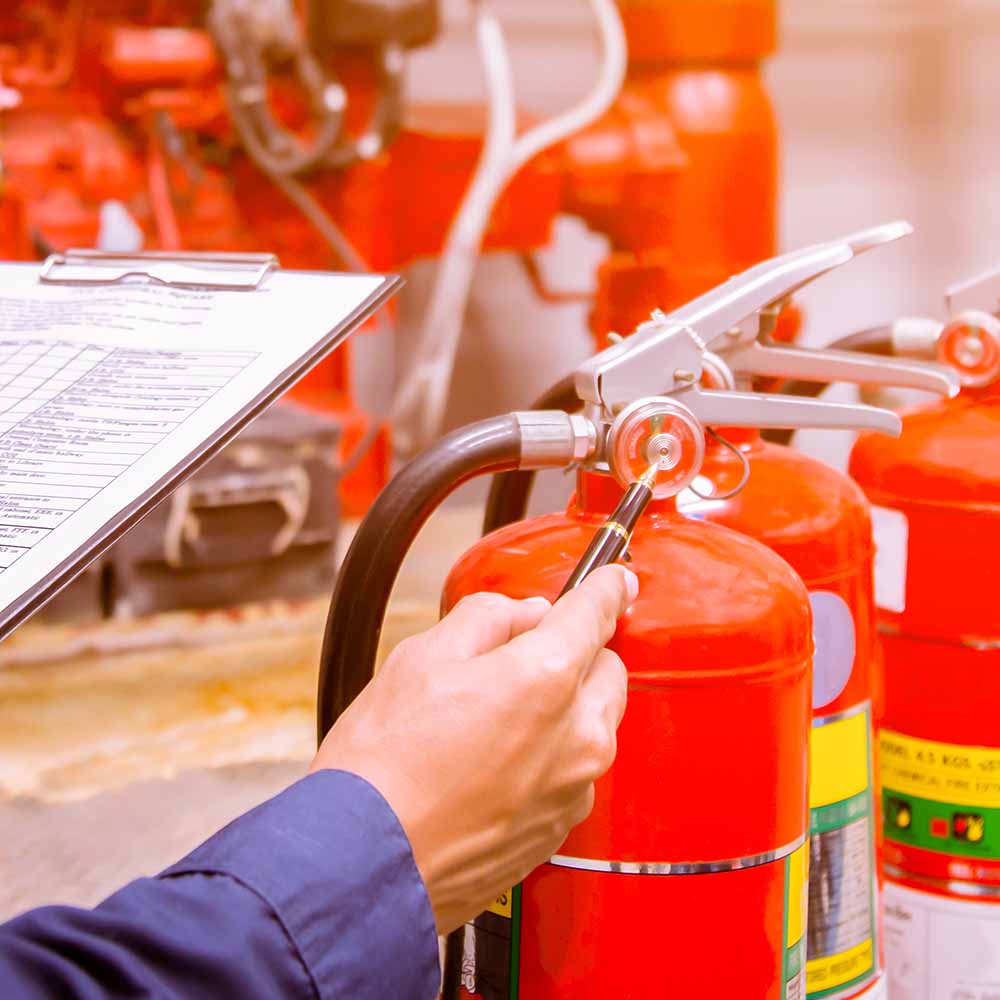

Red fire extinguisher mounted on a white wall in a well-lit corridor with a blurry background.

Fire EXTINGUISHERS & Kitchen Suppression Systems | Tampa, St. Petersburg, Clearwater, Sarasota, orlando

THE FIRST LINE, EVERY TIME IT'S NEEDED.
Be ready before you need to be — with equipment matched to what's actually in the room.
Every fire starts small.
What's on your wall — or hidden in the ceiling — decides what happens next.

Always charged. Always placed. Always the right agent.
REQUEST A FREE ESTIMATE
The first line doesn't get a second chance. It has to work exactly right, the first time it's called on — every time. An overdue extinguisher and an unchecked kitchen suppression system fail the same way: quietly, until the moment they're needed. Stop the fire. Keep the kitchen running. That's the whole job. Piper builds the program either way — acility-matched extinguisher coverage, NFPA 17A kitchen suppression inspections, full compliance lifecycle, fire-marshal-ready documentation for every AHJ from Marion County to Orlando to Lee County.‍
Abstract logo with a dark blue water droplet inside a stylized wave shape formed by a dark blue upper curve and a light blue lower curve.
Person inspecting the pressure gauge of a red fire extinguisher, with more fire extinguishers and a clipboard with a checklist in the background.
What is fire extinguisher and Kitchen Suppression  service?

Fire extinguisher service is the ongoing inspection, maintenance, recharging, and — when required — hydrostatic testing of portable fire extinguishers, performed to keep them compliant with NFPA 10 and ready to perform in an actual fire event. Extinguishers are classified by the fuel type they're designed to fight — Class A (ordinary combustibles), Class B (flammable liquids), Class C (electrical), Class D (combustible metals), and Class K (commercial kitchen grease fires) — with Class K covering the commercial kitchen grease fires a wet chemical kitchen suppression system is built to stop first.

Kitchen suppression system service is the periodic inspection of the wet chemical suppression system installed over a commercial cooking line — Ansul, Pyrochem, Rangeguard, and other manufacturers — verifying tank pressure, detection and fusible links, nozzle alignment, and manual pull stations under NFPA 17A. A suppression system that hasn't been inspected on schedule fails the same way an overdue extinguisher does: quietly, and exactly when a kitchen fire needs it to work.

For either one, Florida code requires a documented inspection program — and equipment that's overdue, undercharged, or mismatched to the hazard is a liability that looks like protection until the moment it's tested.

As part of the Fortis national network, Piper's extinguisher & kitchen suppression expertise is backed by national training standards and technical resources — giving West Central Florida facilities access to the same level of precision engineering as any major market in the country.

Get a Free Estimate

Who needs fire extinguisher & kitchen suppression services

EVERY FACILITY HAS SOMETHING WORTH STOPPING FAST.
Portable fire extinguishers are required by code in virtually every occupied commercial building in Florida — and any facility running a commercial cooking line carries a second, parallel obligation to keep its kitchen suppression system inspected on schedule.

Hospitality (Gulf Coast & Orlando Hotels, Restaurants & Resorts)

Commercial kitchens along Clearwater Beach, Sarasota, and the greater Tampa Bay hospitality corridor, plus Orlando's resort and theme-park district, are Class K territory — grease and cooking-oil fires standard extinguishers can't safely handle.

Marine & Waterfront Facilities

Marinas, boat yards, and waterfront restaurants common along the Gulf Coast, from Tampa Bay down through Charlotte Harbor and Lee County, carry fuel-handling and engine-room hazards that call for Class B coverage.

Multi-Family & Condo High-Rises

Common areas, mechanical rooms, and individual units in the region's coastal condo towers — and in Orlando's growing high-rise residential market — all carry extinguisher requirements that vary by local fire code.

Healthcare

Hospitals and long-term care facilities from Marion County to Orlando to Lee County need extinguisher placement that accounts for both general A/B/C coverage and oxygen-enriched clinical environments.

Office Buildings

Standard A/B/C coverage across Tampa Bay, Orlando, and Lakeland office corridors, placed to satisfy travel-distance and ADA mounting-height requirements.

Warehouse & Distribution Centers

Large footprints along the I-4 corridor connecting Tampa, Lakeland, and Orlando, and along I-75 south into Lee County, mean extended travel distances and equipment areas that often need coverage beyond standard A/B.
Where kitchen suppression inspections matter most.
Any commercial kitchen with a wet chemical suppression system installed over its cooking line needs that system inspected twice a year — not just visually checked:

Full-Service Restaurants & Commercial Kitchens

Every hood-mounted wet chemical system needs functional testing on a fixed schedule, not just a glance at the tank gauge.

Hotel & Resort Kitchens

High-volume hospitality kitchens along the Gulf Coast and Orlando's resort corridor put suppression systems through more wear than a typical restaurant sees.

Institutional & Healthcare Kitchens

Hospital, school, and senior living kitchens carry the same NFPA 17A obligation, with less tolerance for a missed inspection.

Ghost Kitchens & Commissary Kitchens

Growing fast across Florida's delivery-driven food service market, and often the most overlooked when it comes to suppression inspection compliance.

extinguisher And kitchen suppression system CODE & COMPLIANCE

SIMPLE EQUIPMENT. STRICT REQUIREMENTS — AND A SEPARATE STANDARD FOR kitchen suppression SYSTEMS.
Fire extinguisher compliance is governed almost entirely by a single standard — which makes it deceptively easy to assume the whole page falls under one rulebook. It doesn't. A wet chemical kitchen suppression system answers to its own standard, on its own inspection clock.
A person in a gray shirt holding and reviewing documents in a blue folder, standing next to shelves filled with neatly arranged blue binders.

NFPA 10 — Standard for Portable Fire Extinguishers

governs selection, placement, inspection, and maintenance. It requires monthly visual inspections, annual maintenance by a certified technician, internal examination every six years for most rechargeable types, and full hydrostatic testing every twelve years.

NFPA 17A — Standard for Wet Chemical Extinguishing Systems

governs the inspection, testing, and maintenance of kitchen suppression systems. It requires a semi-annual inspection — every six months — by a certified technician: verifying tank pressure, checking the detection and fusible link system, confirming nozzle alignment and blockage-free piping, and testing manual pull stations and fuel/gas shutoff interlocks.

OSHA 29 CFR 1910.157

establishes employer obligations, including extinguisher accessibility, employee training where a facility's fire response plan calls for employee use, and maintenance recordkeeping.

Travel distance and placement

for extinguishers typically caps at a 75-foot travel distance for Class A hazards and 50 feet for Class B — and local fire marshals across Pinellas, Hillsborough, Polk, Sarasota, Lee, and Orange counties, and every other county in Piper's service area, each enforce their own mounting height, signage, and visibility standards.
Piper manages the full inspection tag and documentation trail for both extinguishers and kitchen suppression systems, so a fire marshal walkthrough is never a scramble.
Request a Free Estimate

HOW PIPEr's fire Extinguisher service WORKs

here to help, every step of the way
Every Piper service relationship follows the same standard: thorough assessment, precise execution, clear documentation, and a team that stays accountable long after the work is done.
1

Site Survey & Hazard Assessment

Piper evaluates your facility's specific fire hazards — cooking operations, electrical rooms, flammable storage — to determine the right extinguisher class, size, and count for every zone, and confirms your kitchen suppression system's inspection status if you have one.

2

Placement & Installation

Extinguisher units are mounted to satisfy travel-distance and visibility requirements, with signage and mounting height that meet local code and ADA accessibility standards.

3

Monthly & Annual Inspection Program

Monthly visual checks confirm extinguisher gauge pressure, physical condition, and accessibility. Kitchen suppression systems receive NFPA 17A semi-annual inspection — tank pressure, detection and fusible links, nozzle condition, and pull station function, all tested and documented.

4

Recharge, Replacement & Suppression System Service

Discharged or deficient extinguishers are recharged or replaced on the spot; units due for six-year internal maintenance or twelve-year hydrostatic testing are flagged and serviced on schedule. A kitchen suppression system flagged during inspection is serviced before it becomes a compliance gap — not after.

FREQUENTLY ASKED QUESTIONS

FAQs about fire Extinguishers & Kitchen Suppression Systems
We get asked a lot of questions about our Fire Extinguisher & Kitchen Suppression Services — here are some of the most common.
How often does a fire extinguisher need to be inspected?
NFPA 10 requires a monthly visual inspection and a more thorough annual maintenance inspection performed by a certified technician. Most rechargeable extinguishers also require internal examination every six years and hydrostatic testing every twelve years.
What's the difference between an inspection and a recharge?
An inspection checks whether the unit is present, accessible, properly pressurized, and physically sound. A recharge refills the extinguishing agent after use or when pressure drops below the acceptable range.
How do I know which class of extinguisher I need?
It depends on the fuel sources in each area of your facility — ordinary combustibles (Class A), flammable liquids (Class B), electrical equipment (Class C), combustible metals (Class D), or commercial kitchen grease (Class K). Piper's site survey identifies the right class, size, and placement for every zone.
How often does a kitchen suppression system need to be inspected?
NFPA 17A requires a semi-annual inspection — every six months — performed by a certified technician, covering tank pressure, the detection and fusible link system, nozzle condition, piping, and manual pull station function.
Does OSHA require employee fire extinguisher training?
Only if your facility's emergency action plan designates employees to fight incipient-stage fires themselves. Otherwise, OSHA still requires extinguishers to be accessible and properly maintained.

WHY CHOOSE Piper

THE PIPER DIFFERENCE
Piper has been designing, installing, and servicing fire extinguishers and kitchen suppression systems across Tampa Bay and the Suncoast since 1986. Our technicians hold current certifications in every suppression system type we service. Our managers average 20 years of field experience. And our active involvement in Florida fire safety policy means we know where the codes are going — not just where they are.

As a Fortis company, Piper's suppression programs are backed by national technical standards and resources — delivered by a team that has called West Central Florida home for four decades.
One provider, one schedule.

Extinguisher and kitchen suppression inspections run on the same coordinated calendar as your sprinkler, alarm, and suppression service — nothing falls through the cracks of being everyone's lowest priority.

Certified on every major system.

Piper inspects Ansul, Pyrochem, Captiveair, and Rangeguard wet chemical suppression systems, with technicians trained to each manufacturer's specific inspection requirements — not a generic checklist.

Documentation that holds up.

Every inspection — extinguisher or kitchen suppression system — tagged, logged, and ready to produce the moment a fire marshal asks for it.

Service Area

FIRE EXTINGUISHER & KITCHEN SUPPRESSION SYSTEM COVERAGE

Piper Fire Protection's service area now spans 17 counties across Central and Southwest Florida — including Orlando and the surrounding region — backed by the resources and standards of the Fortis Fire & Safety national network.

‍Part of the Fortis Fire & Safety national network — local expertise, backed by national strength.

‍For national account inquiries, contact our National Accounts team.

‍

Counties served: Marion, Citrus, Hernando, Pasco, Pinellas, Hillsborough, Manatee, Sarasota, Charlotte, Lee, DeSoto, Hardee, Polk, Osceola, Orange, Lake, and Sumter.
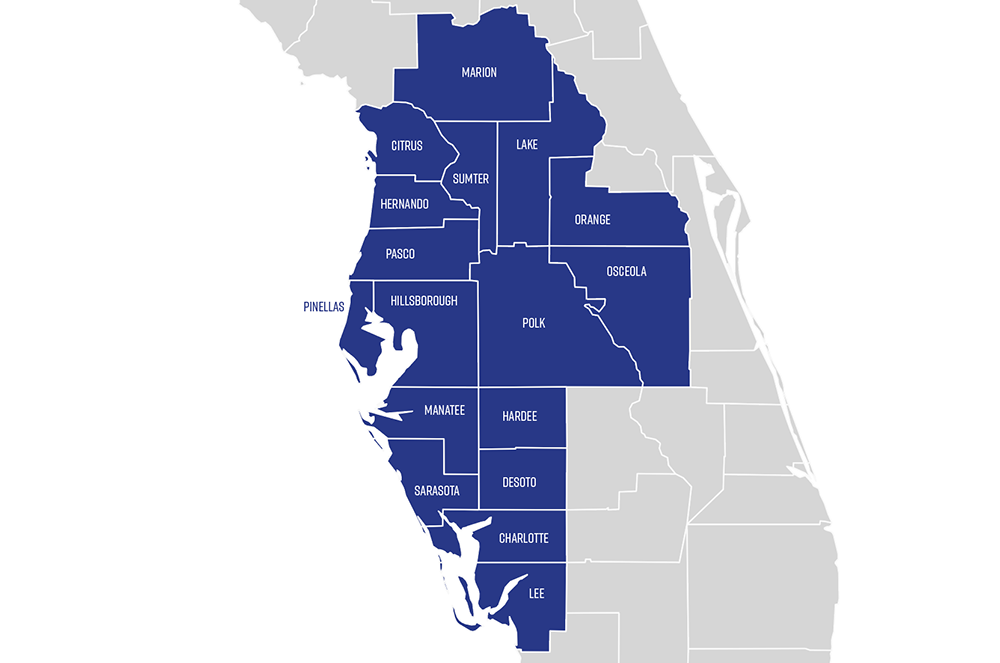
Map highlighting 16 counties in west-central Florida in blue, including Marion, Citrus, Sumter, Hernando, Pasco, Pinellas, Hillsborough, Manatee, Sarasota, Lake, Orange, Osceola, Polk, Hardee, Desoto, Charlotte, and Lee counties.
MAKE SURE IT'S READY BEFORE IT'S NEEDED — WHATEVER'S ON YOUR WALL OR over your cookline.

Talk to a Piper specialist about a fire extinguisher program or kitchen suppression inspection for your facility.

Fortis Family of Brands

Local expertise, national strength
The best of both — in every market we serve.

Trust is built locally. It lives in the technician who knows your building, knows your local codes, and shows up when something goes wrong at midnight. It lives in the relationship between a fire protection company and the community it has served for decades.


But capability is built at scale. The training standards, the technical resources, the purchasing power, the shared knowledge of a unified national organization — these are the things that make a local provider exceptional rather than merely adequate.

Fortis was built on this belief.

Our network of regionally rooted fire and life safety companies delivers genuine local expertise in every market we serve — technicians who know the regional AHJs, the local codes, and the specific demands of the facilities in their community. Behind each of them stands the full weight of a premier national organization.

You build. You create. You push the world forward.
‍We protect it all.
CJ Suppression logo with stylized flames above oval containing 'CJS' text, tagged as a Fortis brand.Diversified Systems, Inc. logo with a downward triangle and horizontal line, A Fortis brand.IFSS logo with Integrated Fire and Security Solutions, a Fortis brand text.LSM shield logo with text LifeSafety Management, a Fortis brand on black background.Piper Fire Protection logo with a stylized water droplet and swoosh, labeled a Fortis brand.VFS logo with a triangular symbol above and text Fire & Security Services, A Fortis BrandLAMARCO SYSTEMS logo with text Life Safety & Integrated Security Solutions, a FORTIS brand.