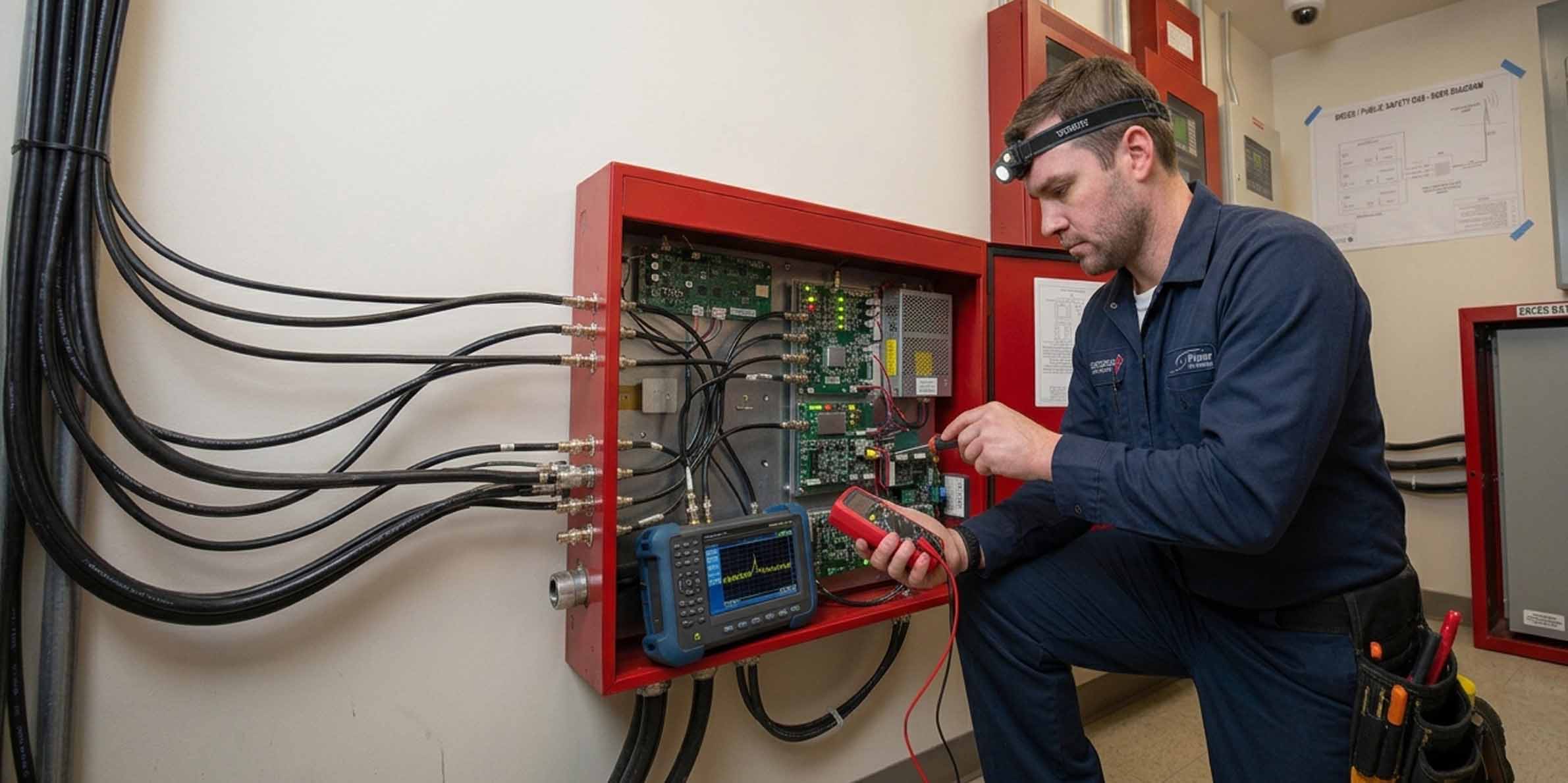
Technician wearing a headlamp and navy coverall kneeling while testing a red and black ERCES electronic control panel with multiple cables and circuit boards using diagnostic tools in a utility room.

ERCES & DAS Systems | Tampa, St. Petersburg, Clearwater, Sarasota, Orlando

WHEN RESPONDERS NEED TO TALK, YOUR BUILDING NEEDS TO LISTEN.
A fire doesn't pause for a dead zone. Neither can your building's response.
Give first responders a signal they can trust, floor to floor, wall to wall.
Full coverage. No dead air. Every floor accounted for.
REQUEST A FREE ESTIMATE
A fire doesn't wait for a strong signal. Neither should the responders trying to fight it. Emergency Responder Communication Enhancement System (ERCES) and Distributed Antenna Systems (DAS) exist for one reason: to make sure fire, police, and EMS teams can talk to each other and to command, everywhere inside your building — stairwells, basements, parking structures, the places where radio signal goes to die. Guarantee the connection. Guide the response. Protect the responders protecting you. In many buildings in Florida, this isn't a nice-to-have: code requires it. Piper designs, installs, and maintains systems that meet that mandate — and hold up when they're tested.
Abstract logo with a dark blue water droplet inside a stylized wave shape formed by a dark blue upper curve and a light blue lower curve.
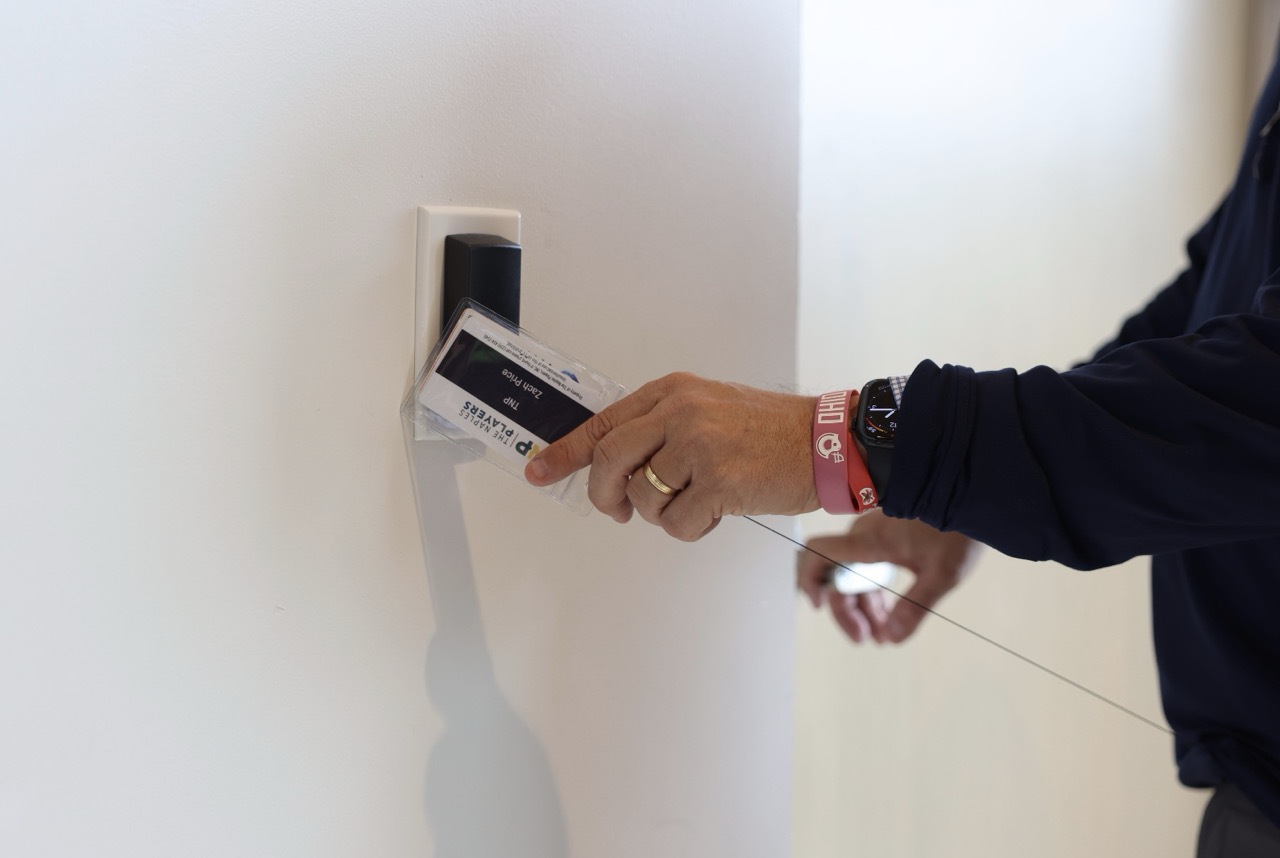
A person holding an access card against a wall-mounted card reader, with the card showing the name 'Zach Price' and 'The Players' logo.
What is an ERCES/DAS system?

An Emergency Responder Communication Enhancement System (ERCES) — formerly known as Emergency Responder Radio Communication System (ERRCS) — often deployed via a Distributed Antenna System (DAS), is in-building infrastructure that captures public safety radio frequencies from outside a building and rebroadcasts them throughout the interior — including stairwells, parking garages, and below-grade areas where signal from outside towers can't reach.

A Bi-Directional Amplifier (BDA) receives and boosts the signal; a network of interior antennas distributes it. Across Piper's Central and Southwest Florida service area — where concrete high-rise construction and below-grade parking are common from the Gulf Coast to Orlando's urban core — ERCES/DAS is a code requirement enforced at both initial certificate of occupancy and annual recertification — not an optional upgrade.

As a Fortis company, Piper's programs are backed by national technical standards and resources — delivered by a team embedded in the West Central Florida community.

Get a Free Estimate

Who needs ERRCS & DAS systems

DENSE CONSTRUCTION CREATES DEAD ZONES.
DEAD ZONES CREATE RISK.
Across Piper's Central and Southwest Florida service area, ERCES/DAS requirements are triggered less by industry and more by a building's size, height, and construction — though certain occupancies see the strictest scrutiny once those thresholds are crossed.

Hospitality (Gulf Coast & Orlando Hotels & Resorts)

Clearwater Beach, Sarasota, and St. Pete high-rise resorts, along with Orlando's resort and convention corridor, combine below-grade parking, concrete construction, and dense guest-room floor plans — a common ERCES/DAS trigger, and a dead zone during an active event puts guests and responders at risk together.

Healthcare

Hospitals and long-term care facilities across Pinellas, Hillsborough, Polk, Sarasota, Lee, and Orange counties combine large footprints with zero tolerance for a communication failure mid-response.

Multi-Family & Condo High-Rises

Florida's Gulf Coast, from Pinellas down through Lee County, is lined with concrete condo towers and below-grade parking garages, and Orlando's high-rise residential market is catching up fast — exactly the construction that blocks standard radio signal and triggers code review.

Education

Growing campuses across Tampa Bay, Orlando, and Lakeland with below-grade infrastructure increasingly fall under ERCES/DAS mandates as they build taller and denser.

Large & High-Rise Buildings

Florida Building Code Section 510 applies to buildings of 50,000 square feet or more and any structure three stories or higher — a threshold a lot of coastal construction crosses without anyone realizing it.

Office Buildings

Class A towers in Tampa Bay, Orlando, and Lee County face close AHJ scrutiny, both for initial certificate of occupancy and the annual recertification testing after.

ERRCS & DAS system CODE & COMPLIANCE

FLORIDA'S STANDARDS ARE STRICT.
SO IS OUR RECORD OF MEETING THEM.
ERCES/DAS compliance in Florida sits at the intersection of the Florida Building Code, FCC radio licensing, and local AHJ interpretation.
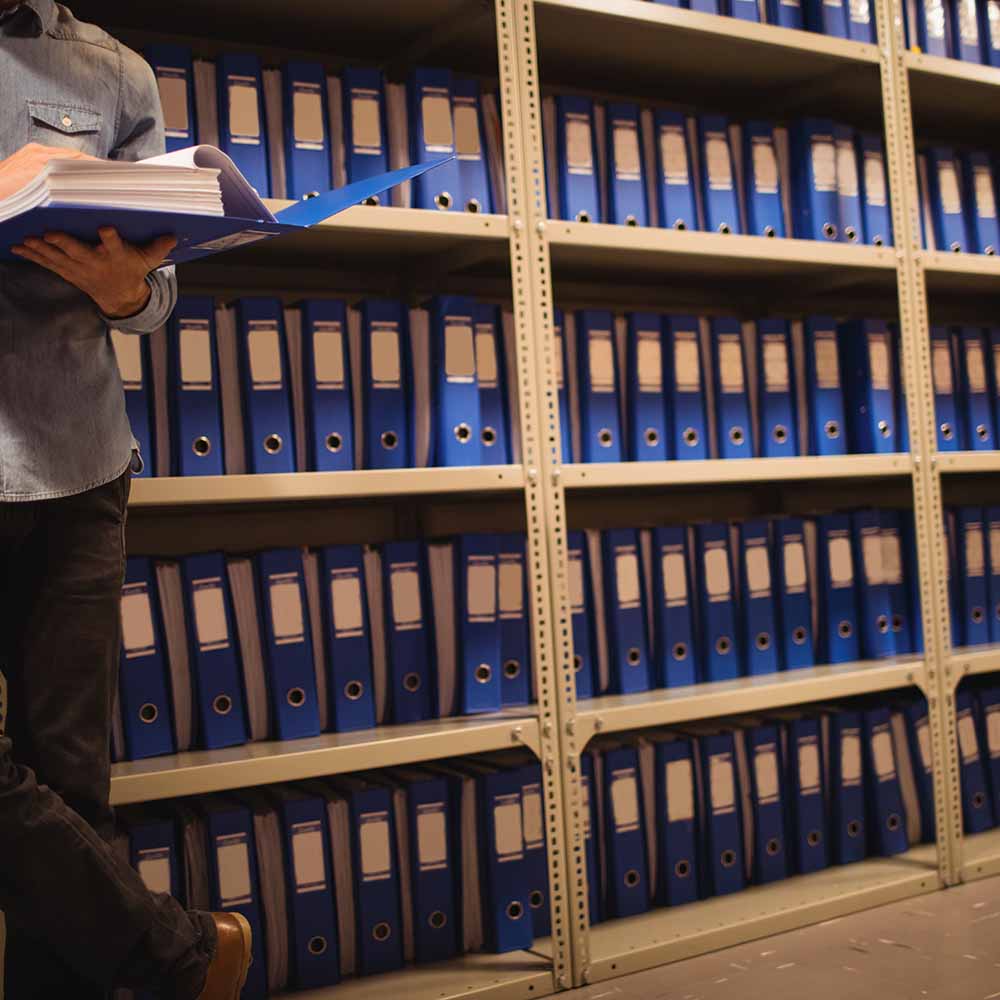
A person in a gray shirt holding and reviewing documents in a blue folder, standing next to shelves filled with neatly arranged blue binders.

Florida Building Code (FBC) Section 510

governs ERCES/DAS requirements statewide, mandating reliable in-building coverage — typically benchmarked at 95% or higher — in buildings over 50,000 square feet and in high-rise structures. The technical design methodology follows NFPA 1225's coverage and testing standards: 99% signal coverage in critical areas (fire command centers, stairwells, elevator lobbies) and 90% in general building areas.

Local AHJ enforcement

varies by county. In Pinellas County, the Fire Marshal and the County's Radio Department of Safety & Emergency Services jointly determine coverage requirements and issue Retransmission Authorization — a separate, required step from fire code sign-off. Hillsborough, Manatee, Sarasota, Polk, Lee, and Orange County AHJs each layer their own interpretation and testing standards on top of the state code — and the same holds true across every county in Piper's expanded Central and Southwest Florida footprint, from Marion County down to Lee County. Piper technicians work directly with all of them.

FCC Part 90 rules

govern the radio spectrum these systems operate on. Installing or servicing a BDA/DAS system legally requires a technician holding a General Radiotelephone Operator License (GROL) — a credential many providers in this space don't actually carry.

Retrofit requirements are moving.

Recent Florida legislative updates are phasing in stricter retrofit timelines for existing buildings — which means a building that was compliant when it was built may not stay compliant without a fresh look.
Piper manages the compliance burden so you don't have to piece it together from three different regulatory bodies at once.
Request a Free Estimate

HOW PIPEr's ERRCS & DAS systems service WORKs

here to help, every step of the way
Every Piper service relationship follows the same standard: thorough assessment, precise execution, clear documentation, and a team that stays accountable long after the work is done.
1

Building Survey & RF Coverage Testing

Every engagement starts with a full radio-frequency survey — floor by floor, garage level by garage level — to map existing signal and flag gaps before the AHJ does.
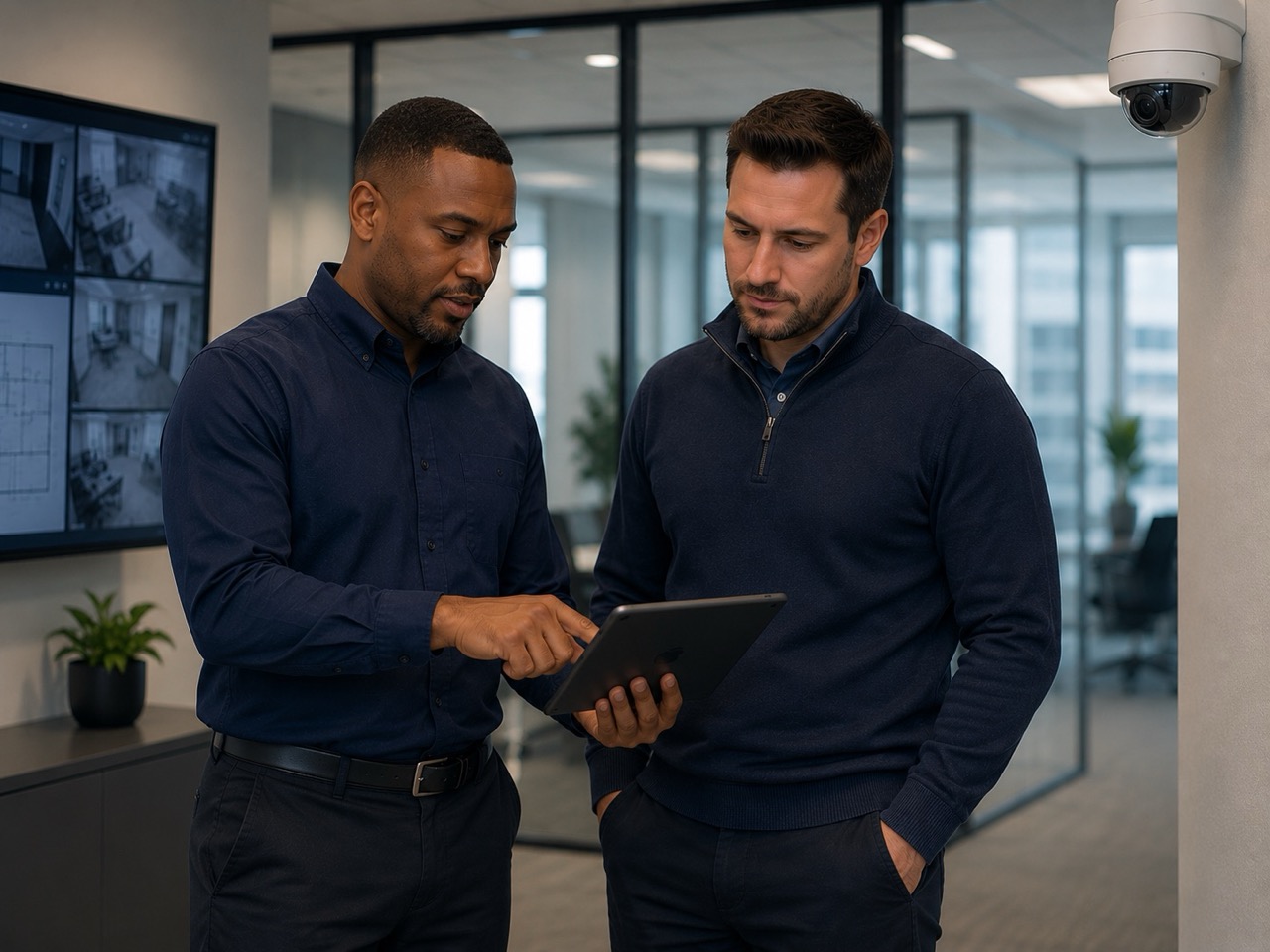
Two men in dark clothing discussing security footage on a tablet in an office with a security camera mounted on a wall and a monitor showing surveillance images in the background.
2

System Design

Piper engineers design BDA capacity, antenna placement, and enclosure specs around your building's actual construction — concrete high-rise, below-grade garage, hurricane-rated shell — not a generic amplifier dropped in a closet.

Two men in an office corridor; one man is holding and pointing at a blueprint while the other uses an access card on a door's security reader and holds a tablet.
3

Installation & Alarm Integration

Installation integrates with your existing fire alarm system, so signal troubles report through the same monitoring pathway your fire systems already use.
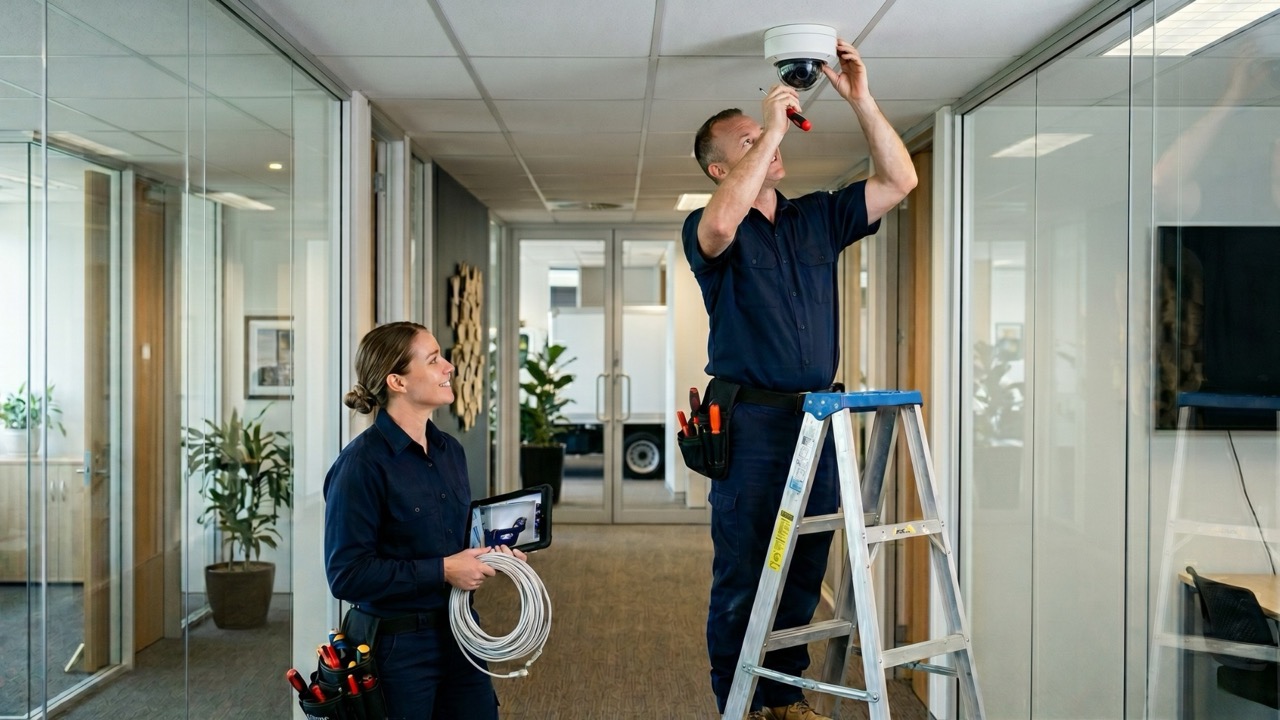
Two technicians in navy uniforms install a ceiling security camera in a modern office hallway; one stands on a ladder adjusting the camera while the other holds a coil of cable and a tablet showing a camera view.
4

Acceptance Testing & AHJ Sign-Off

Piper manages acceptance testing directly with your local AHJ — Pinellas, Hillsborough, Polk, Sarasota, Lee, Orange County, or anywhere else across Piper's service area — documenting coverage in the format your jurisdiction requires for certificate of occupancy approval. Ongoing monitoring and annual recertification keep your system, and your CO, from ever lapsing.

Smiling woman wearing a headset holding a tablet in an office setting.

FREQUENTLY ASKED QUESTIONS

FAQs about ERCES & DAS systems
We get asked a lot of questions about our ERCES & DAS Systems — here are some of the most common.
What's the difference between a DAS and a commercial cell signal booster?
A commercial cell booster amplifies consumer cellular signal for convenience. An ERCES/DAS system is licensed, code-mandated infrastructure built specifically to carry public safety radio frequencies for fire, police, and EMS communication — a fundamentally different, far more regulated system, even though the antenna hardware looks similar.
Is ERCES/DAS required in my building?
It depends on your building's size and construction. Under Florida Building Code Section 510, most buildings over 50,000 square feet or three stories and higher require ERCES/DAS coverage — and below-grade parking or concrete construction can trigger the requirement even in smaller buildings. Piper can run an RF coverage survey to tell you definitively.
What happens if my building fails its ERCES/DAS recertification test?
Local AHJs can flag the building as non-compliant, which puts your certificate of occupancy at risk and may require immediate remediation. Piper identifies and fixes coverage gaps before the annual test, not after.
Who is legally allowed to install or service a DAS/BDA system?
Only a technician holding an FCC General Radiotelephone Operator License (GROL) can legally install or service a BDA/DAS system. Every Piper technician working on ERCES/DAS holds that credential.
How long does an ERCES/DAS installation take?
Timelines vary with building size and construction, but most projects move from RF survey to AHJ sign-off in weeks, not months. Piper scopes an exact timeline after the initial coverage survey.
Does the system need battery backup?
Yes. NFPA 1225 requires a minimum 24-hour battery backup for ERCES/DAS systems, ensuring responder communication stays live even if a building loses power during an emergency.

WHY CHOOSE Piper

THE PIPER DIFFERENCE
Most building owners never think about ERRCS/DAS until an AHJ flags it during a permit review — and by then, the clock is already running against a certificate of occupancy deadline.
Licensed, not just installed.

Every Piper technician working on your system holds FCC GROL certification — the legal minimum, and not every provider in this space actually meets it.

Local trust, backed by national resources.

Piper has served the Tampa Bay area since 1986. As part of the Fortis Fire & Safety network, that local relationship is now backed by the training standards, technical resources, and shared expertise of a premier national organization.

Coverage that holds up under AHJ scrutiny.

Piper designs to the coverage percentages Pinellas, Hillsborough, Polk, Sarasota, Lee, and Orange County actually enforce, and documents testing in the format each AHJ expects.

Service Area

ERCES & DAS system coverage

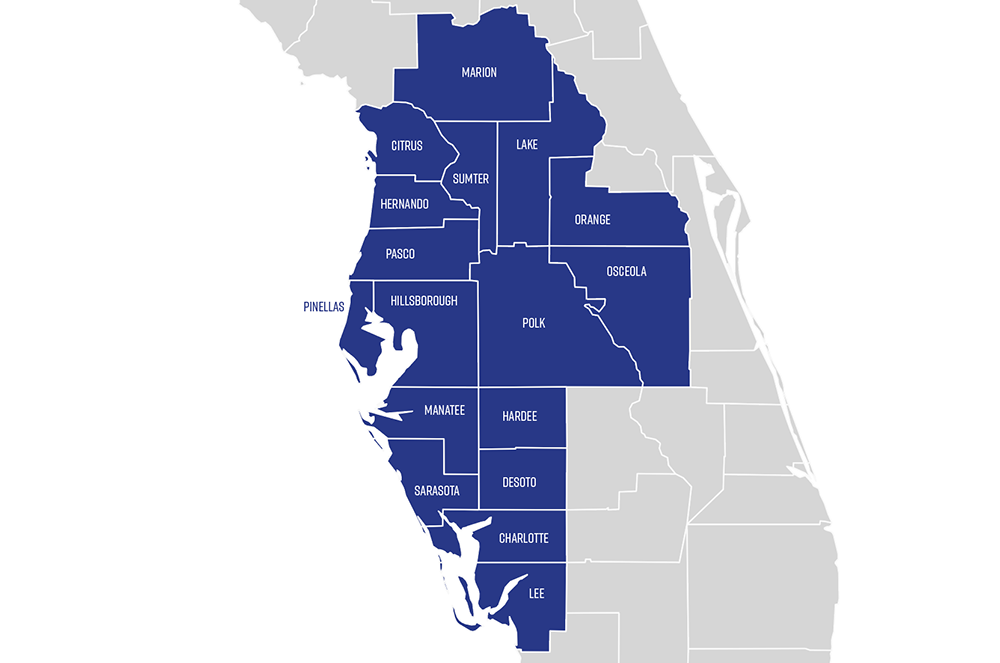
Piper Fire Protection's service area now spans 17 counties across Central and Southwest Florida — including Orlando and the surrounding region — backed by the resources and standards of the Fortis Fire & Safety national network.

‍Part of the Fortis Fire & Safety national network — local expertise, backed by national strength.

‍For national account inquiries, contact our National Accounts team.

‍

Counties served: Marion, Citrus, Hernando, Pasco, Pinellas, Hillsborough, Manatee, Sarasota, Charlotte, Lee, DeSoto, Hardee, Polk, Osceola, Orange, Lake, and Sumter.
‍

Map highlighting 16 counties in west-central Florida in blue, including Marion, Citrus, Sumter, Hernando, Pasco, Pinellas, Hillsborough, Manatee, Sarasota, Lake, Orange, Osceola, Polk, Hardee, Desoto, Charlotte, and Lee counties.
DON'T LET A DEAD ZONE JEOPARDIZE YOUR C.O.

Talk to a Piper ERCES/DAS specialist about your building's coverage requirements.

Fortis Family of Brands

Local expertise, national strength
The best of both — in every market we serve.

Trust is built locally. It lives in the technician who knows your building, knows your local codes, and shows up when something goes wrong at midnight. It lives in the relationship between a fire protection company and the community it has served for decades.


But capability is built at scale. The training standards, the technical resources, the purchasing power, the shared knowledge of a unified national organization — these are the things that make a local provider exceptional rather than merely adequate.

Fortis was built on this belief.

Our network of regionally rooted fire and life safety companies delivers genuine local expertise in every market we serve — technicians who know the regional AHJs, the local codes, and the specific demands of the facilities in their community. Behind each of them stands the full weight of a premier national organization.

You build. You create. You push the world forward.
‍We protect it all.
CJ Suppression logo with stylized flames above oval containing 'CJS' text, tagged as a Fortis brand.Diversified Systems, Inc. logo with a downward triangle and horizontal line, A Fortis brand.IFSS logo with Integrated Fire and Security Solutions, a Fortis brand text.LSM shield logo with text LifeSafety Management, a Fortis brand on black background.Piper Fire Protection logo with a stylized water droplet and swoosh, labeled a Fortis brand.VFS logo with a triangular symbol above and text Fire & Security Services, A Fortis BrandLAMARCO SYSTEMS logo with text Life Safety & Integrated Security Solutions, a FORTIS brand.